{
"mcpServers": {
"agentforce-mcp-server": {
"command": "<see-readme>",
"args": []
}
}
}No install config available. Check the server's README for setup instructions.
Are you the author?
Add this badge to your README to show your security score and help users find safe servers.
Is it safe?
No package registry to scan.
No authentication — any process on your machine can connect.
License not specified.
Is it maintained?
Last commit 383 days ago. 5 stars.
Will it work with my client?
Transport: stdio. Works with Claude Desktop, Cursor, Claude Code, and most MCP clients.
No automated test available for this server. Check the GitHub README for setup instructions.
No known vulnerabilities.
This server is missing a description. Tools and install config are also missing.If you've used it, help the community.
Add informationHave you used this server?
Share your experience — it helps other developers decide.
Sign in to write a review.
Persistent memory using a knowledge graph
Privacy-first. MCP is the protocol for tool access. We're the virtualization layer for context.
Pre-build reality check. Scans GitHub, HN, npm, PyPI, Product Hunt — returns 0-100 signal.
Monitor browser logs directly from Cursor and other MCP compatible IDEs.
MCP Security Weekly
Get CVE alerts and security updates for Agentforce Mcp Server and similar servers.
Start a conversation
Ask a question, share a tip, or report an issue.
Sign in to join the discussion.

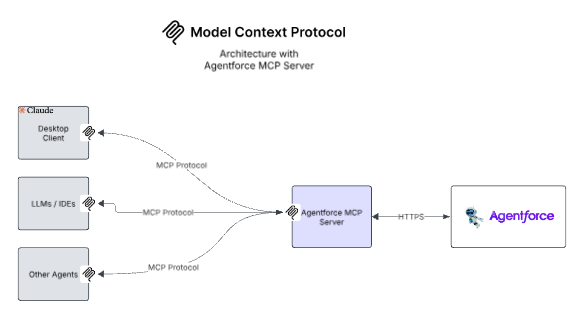
This is an MCP (Model Context Protocol) server for Salesforce's Agentforce Service Agent. THe MCP Server uses Agentforce Agent API to communicate with the Agent while exposing the main API interfaces as Tools based on the MCP Protocol.
| Tool Name | Description | | ------------- | ---------------------------------------- | | start-session | Initializes a new Agentforce chat session| | send-message | Sends a message to the active session | | end-session | Ends the active session |
npm install
Or if you're setting up from scratch:
npm install @modelcontextprotocol/sdk axios zod
npm run build
Use an MCP-compatible client (like MCP Inspector) to call tools and verify responses https://modelcontextprotocol.io/docs/tools/inspector.
npx @modelcontextprotocol/inspector node ./build/server.js \
<SALESFORCE_ORG_DOMAIN_URL > \
<CONNECTEDAPP_CLIENTID> \
<CONNECTEDAPP_CLIENTSECRET> \
<AGENTID>
All errors are standardized using a centralized error handler. If something goes wrong (e.g., authentication failure), meaningful messages will be shown.
The following uses stdio so the mcp server is running locally.
{
"mcpServers": {
"agentforce" : {
"command": "node",
"args": [
"/path/to/directory/build/server.js",
"SALESFORCE_ORG_DOMAIN_URL",
"CONNECTEDAPP_CLIENT_ID",
"CONNECTEDAPP_CLIENT_SECRET",
"AGENT_ID"
]
}
}
}
##💡 Notes
This server uses STDIO transport. If you want to use SSEServerTransport use the sample below
import { SSEServerTransport } from "@modelcontextprotocol/sdk/server/sse.js";
import express from "express";
const app = express();
var transport: SSEServerTransport ;
app.get("/sse", async (req, res) => {
transport = new SSEServerTransport("/messages", res);
await server.connect(transport);
});
app.post("/messages", async (req, res) => {
// Note: to support multiple simultaneous connections, these messages will
// need to be routed to a specific matching transport. (This logic isn't
// implemented here, for simplicity.)
await transport.handlePostMessage(req, res);
});
app.listen(PORT);