Hands-on workshop: Build a multi-agent AI system from scratch — Deep Research Agent + Writing Workflow served as MCP servers. Includes code, slides, and video (coming soon)
{
"mcpServers": {
"designing-real-world-ai-agents-workshop": {
"command": "<see-readme>",
"args": []
}
}
}No install config available. Check the server's README for setup instructions.
Are you the author?
Add this badge to your README to show your security score and help users find safe servers.
Hands-on workshop: Build a multi-agent AI system from scratch — Deep Research Agent + Writing Workflow served as MCP servers. Includes code, slides, and video (coming soon)
Is it safe?
No package registry to scan.
No authentication — any process on your machine can connect.
MIT. View license →
Is it maintained?
Last commit 0 days ago. 31 stars.
Will it work with my client?
Transport: stdio. Works with Claude Desktop, Cursor, Claude Code, and most MCP clients.
No automated test available for this server. Check the GitHub README for setup instructions.
No known vulnerabilities.
This server is missing a description. Tools and install config are also missing.If you've used it, help the community.
Add informationHave you used this server?
Share your experience — it helps other developers decide.
Sign in to write a review.
Dynamic problem-solving through sequential thought chains
A Model Context Protocol server for searching and analyzing arXiv papers
An open-source AI agent that brings the power of Gemini directly into your terminal.
The official Python SDK for Model Context Protocol servers and clients
MCP Security Weekly
Get CVE alerts and security updates for Designing Real World Ai Agents Workshop and similar servers.
Start a conversation
Ask a question, share a tip, or report an issue.
Sign in to join the discussion.
A hands-on workshop building a multi-agent AI system with two MCP servers: a Deep Research Agent and a LinkedIn Writing Workflow. Both connected to a harness like Claude Code or Cursor.
Built as a lightweight companion to the Agentic AI Engineering Course, which covers 34 lessons and three end-to-end portfolio projects. This workshop distills the core agentic patterns into a ~2-hour hands-on build.
Link to the slides here.
Deep Research Agent — An MCP server that runs deep research using Gemini with Google Search grounding and native YouTube video analysis:
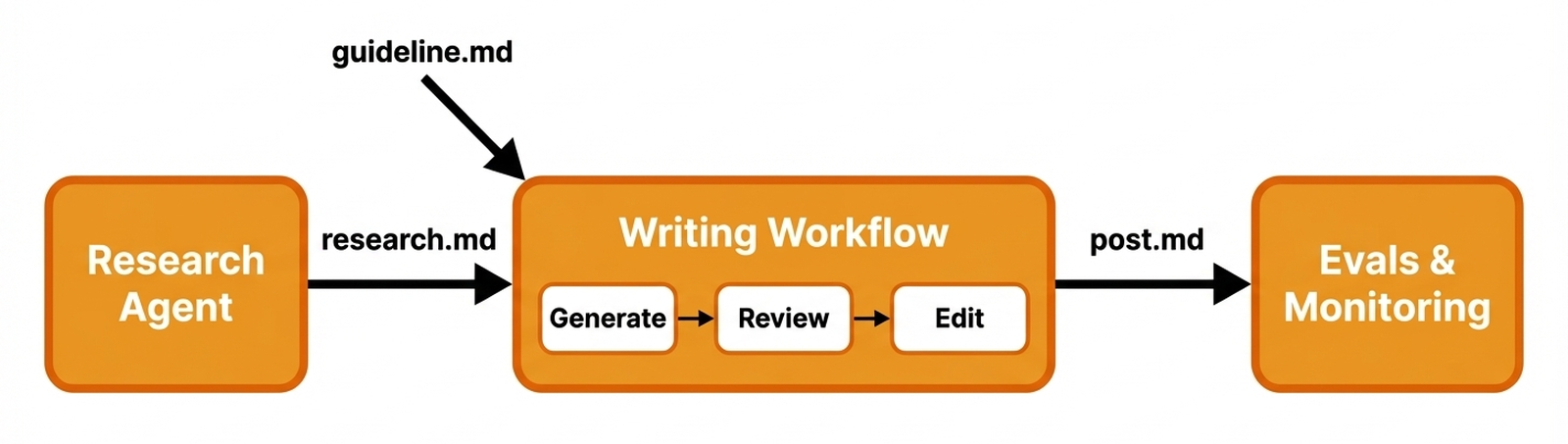
user topic → [deep_research] × N → analyze_youtube_video (if URLs) → [deep_research gap-fill] → compile_research → research.md
LinkedIn Writing Workflow — An MCP server that generates LinkedIn posts with an evaluator-optimizer loop:
research.md + guideline → generate post → [review → edit] × N → post.md → generate image
Both servers expose tools, resources, and prompts via the Model Context Protocol, letting any MCP-compatible harness orchestrate the workflow.
Patterns and concepts you'll learn:
Here's a real run through the full pipeline — from a topic seed to a published-ready LinkedIn post with an AI-generated image.
|
Phil Tobaloo
AI Engineer | I ship AI products and teach you about the process. We planned 12 AI agents and shipped 1. It worked better. Sounds crazy, right? But it's a common story. A client built an AI marketing chatbot. Their initial design had dozens of agents: orchestrator, validators, spam prevention. It failed. A single agent with tools won. Tasks were tightly coupled. One brain maintained context. Tools were still specialized. This is the core mistake. People jump to complex multi-agent setups too fast. Think AI system design as a spectrum:
... A single agent works for most cases. But it has limits. Too many tools? You hit "context rot." Past ~10-20 tools, LLMs degrade at tool selection. They get overwhelmed. Information gets lost in the middle. So, when do you actually need multi-agent? ... The simplest system that reliably solves the problem is always the best system. Don't overengineer your AI agents. Build simple first. What's the most complex agent architecture you've simplified? Tell me below.
|
A short research brief with 2-3 questions and reference links:
# Research Topic: AI Agent Architecture — When Less Is More
## Key Questions
1. Why do single-agent architectures with smart tools outperform multi-agent systems?
2. What are the only legitimate reasons to adopt a multi-agent architecture?
## References
- Stop Over
... [View full README on GitHub](https://github.com/iusztinpaul/designing-real-world-ai-agents-workshop#readme)