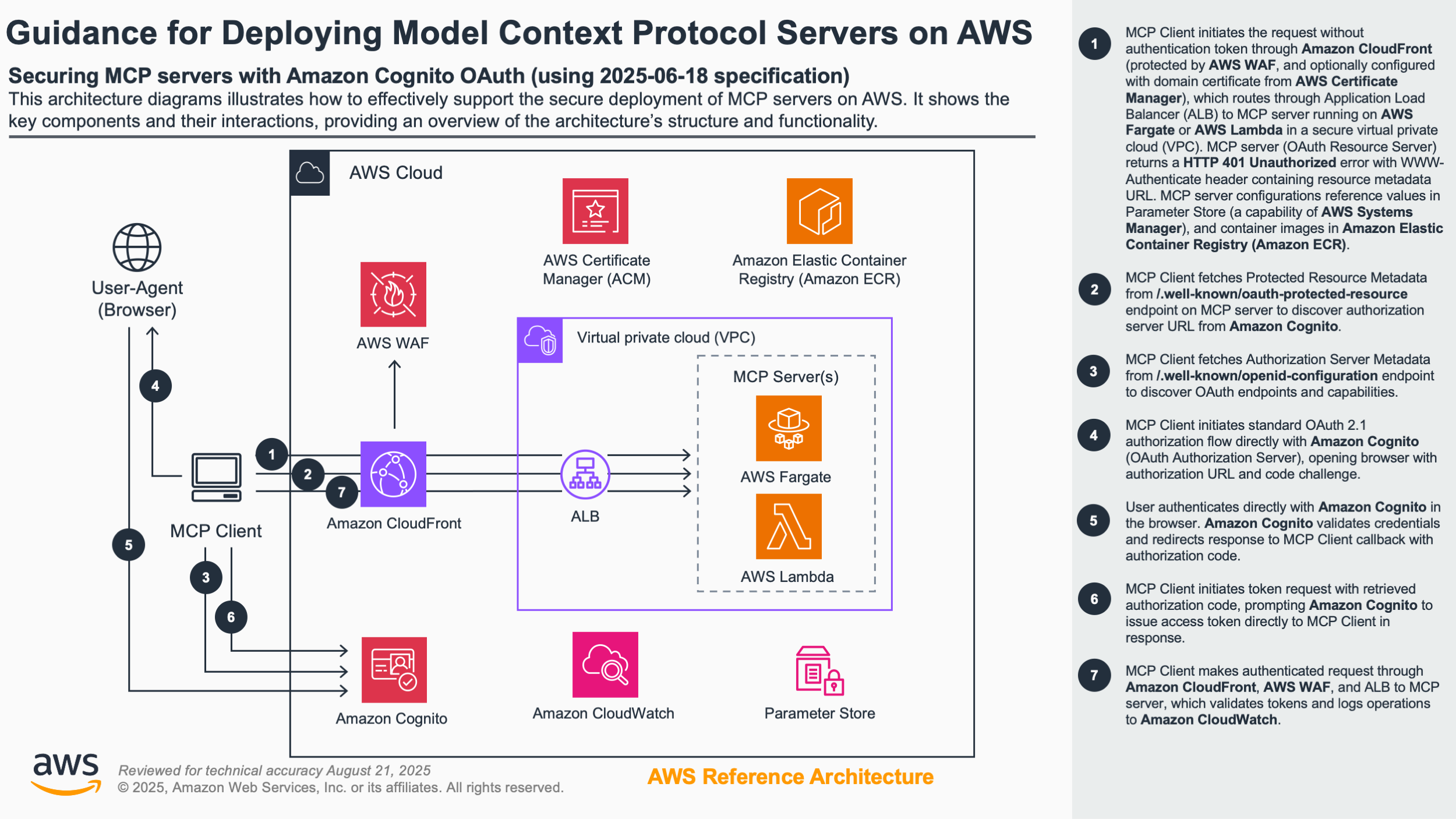
Guidance For Deploying Model Context Protocol Servers On Aws
aws-cdk · by aws-solutions-library-samples
This Guidance demonstrates how to securely run Model Context Protocol (MCP) servers on the AWS Cloud using containerized architecture. It helps organizations implement industry-standard OAuth 2.0 authentication while protecting server deployments with multiple security layers, including content delivery networks and web application firewalls.
No known CVEs
MIT-0 license
Maintained
Last commit 105d ago
Untested
Transport: sse, http
0 tools
Grade F
Step 1
Install in your client
Config is the same across clients — only the file and path differ.
CD
Untested on Claude Desktopsse, http · Node 18+
Paste into ~/Library/Application Support/Claude/claude_desktop_config.json
{
  "mcpServers": {
    "guidance-for-deploying-model-context-protocol-servers-on-aws": {
      "args": [
        "-y",
        "aws-cdk"
      ],
      "command": "npx"
    }
  }
}
Are you the author?
Add this badge to your README to show your security score and help users find safe servers.
Embed in your READMEAbout badges →
[](https://mcppedia.org/s/guidance-for-deploying-model-context-protocol-servers-on-aws)
Read me
What Guidance For Deploying Model Context Protocol Servers On Aws does
- Prerequisites - Operating System 3. Deployment Steps 4. Deployment Validation 5. Running the Guidance 8. FAQ, known issues, additional considerations, and limitations
Test This Server
This server supports HTTP transport. Be the first to test it — help the community know if it works.
Loading README…
Scored, not listed
Why this score
Five weighted categories — click any category to see the underlying evidence.
Score breakdown
55/100across 5 weighted dimensions
0255075100
22
12
15
−45
Security
Maintenance
Efficiency
Documentation
Compatibility
Categoriesclick a row to see evidence
Security
OSV.dev7 fixed
GHSA-4gg8-gxpx-9rphinfo · fixed
uv is vulnerable to arbitrary file write through entry point names
### Impact In versions of uv prior to 0.11.15, when installing a distribution containing an entry point specification (under `console_scripts` or `gui_scripts`), uv would place the generated entry point according to the given name even if doing so resulted in a path outside of the environment's scripts directory. A malicious wheel could use this to place an executable outside of the intended environment, including in a directory already present on the user's `PATH`. This could shadow or overwr
GHSA-pjjw-68hj-v9mwmedium · fixedCVSS 4
uv vulnerable to arbitrary file deletion through RECORD entries
## Impact Wheel RECORD entries can contain relative paths that traverse outside of the wheel’s installation prefix. In versions 0.11.5 and earlier of uv, these wheels were not rejected on installation and the RECORD was respected without validation on uninstall. uv uses the RECORD to determine files to remove on uninstall. Consequently, a malicious or malformed wheel could induce deletion of arbitrary files outside of the wheel’s installation prefix on uninstall. uv does not use the RECORD fi
CVE-2025-13327medium · fixedCVSS 4
uv allows ZIP payload obfuscation through parsing differentials
### Impact In versions 0.9.5 and earlier of uv, ZIP archives were handled in a manner that enabled two parsing differentials against other components of the Python packaging ecosystem: 1. Central directory entries in a ZIP archive can contain comment fields. However, uv would assume that these fields were not present, since they aren't widely used. Consequently, a ZIP archive could be constructed where uv would interpret the contents of a central directory comment field as ZIP control structur
GHSA-w476-p2h3-79g9info · fixed
uv has differential in tar extraction with PAX headers
### Impact In versions 0.9.4 and earlier of uv, tar archives containing PAX headers with file size overrides were not handled properly. As a result, an attacker could contrive a source distribution (as a tar archive) that would extract differently when installed via uv versus other Python package installers. The underlying parsing differential here originates with astral-tokio-tar, which disclosed this vulnerability as CVE-2025-62518. In practice, the impact of this vulnerability is **low**:
CVE-2025-54368medium · fixedCVSS 4
uv allows ZIP payload obfuscation through parsing differentials
## Impact In versions 0.8.5 and earlier of uv, remote ZIP archives were handled in a streamwise fashion, and file entries were not reconciled against the archive's central directory. This enabled two parser differentials against other Python package installers: 1. An attacker could contrive a ZIP archive that would extract with legitimate contents on some package installers, and malicious contents on others due to multiple local file entries. The attacker could choose which installer to target
Community
Reviews
Be the first to review
Have you used this server?
Share your experience — it helps other developers decide.
How easy was setup?Did it work reliably?How was the documentation?
Sign in to write a review.
Frequently Asked Questions
- Is Guidance For Deploying Model Context Protocol Servers On Aws safe to use?
- Guidance For Deploying Model Context Protocol Servers On Aws has no known CVEs as of the latest MCPpedia security scan. It does not require authentication, so any local process can connect — keep this in mind in shared environments. Licensed under MIT-0.
- How do I install Guidance For Deploying Model Context Protocol Servers On Aws?
- Guidance For Deploying Model Context Protocol Servers On Aws supports copy-paste install configs on its MCPpedia page for Claude Desktop, Cursor, and Claude Code. Scroll to the Quick Install section and select your client.
- Is Guidance For Deploying Model Context Protocol Servers On Aws actively maintained?
- Guidance For Deploying Model Context Protocol Servers On Aws is less actively maintained — last commit was 105 days ago. It has 151 GitHub stars.
Related
Similar servers
Others in cloud / security / developer-tools
 XcodeBuildMCP97
A Model Context Protocol (MCP) server and CLI that provides tools for agent use when working on iOS and macOS projects.
5.8k 2
X
XcodeBuildMCP97XcodeBuildMCP provides tools for Xcode project management, simulator management, and app utilities.
5.8k 1
 Figma Console Mcp96
MCP server for accessing Figma plugin console logs and screenshots via Cloudflare Workers or local mode
1.7k 2
G
Mcp Gitlab96MCP server for using the GitLab API
1.6k 12
MCP Security Weekly
Get CVE alerts and security updates for Guidance For Deploying Model Context Protocol Servers On Aws and similar servers.
Community
Discussion
Start a conversation
Ask a question, share a tip, or report an issue.
Has anyone used this with Cursor?How do you handle auth?Any alternatives?
Sign in to join the discussion.