Guidance For Vibe Coding With Aws Mcp Servers
pnpm · by aws-solutions-library-samples
Hands-on guidance for AI-accelerated AWS development using AWS MCP Servers. Learn to leverage AI coding assistants to enhance your development workflows with AWS best practices.
No known CVEs
MIT license
Maintained
Last commit 67d ago
Works with most clients
Transport: stdio, sse, http
0 tools
Grade F
Step 1
Install in your client
Config is the same across clients — only the file and path differ.
CD
Supported in Claude Desktopstdio, sse, http · Node 18+
Paste into ~/Library/Application Support/Claude/claude_desktop_config.json
{
  "mcpServers": {
    "guidance-for-vibe-coding-with-aws-mcp-servers": {
      "args": [
        "-y",
        "pnpm"
      ],
      "command": "npx"
    }
  }
}
Are you the author?
Add this badge to your README to show your security score and help users find safe servers.
Embed in your READMEAbout badges →
[](https://mcppedia.org/s/guidance-for-vibe-coding-with-aws-mcp-servers)
Read me
What Guidance For Vibe Coding With Aws Mcp Servers does
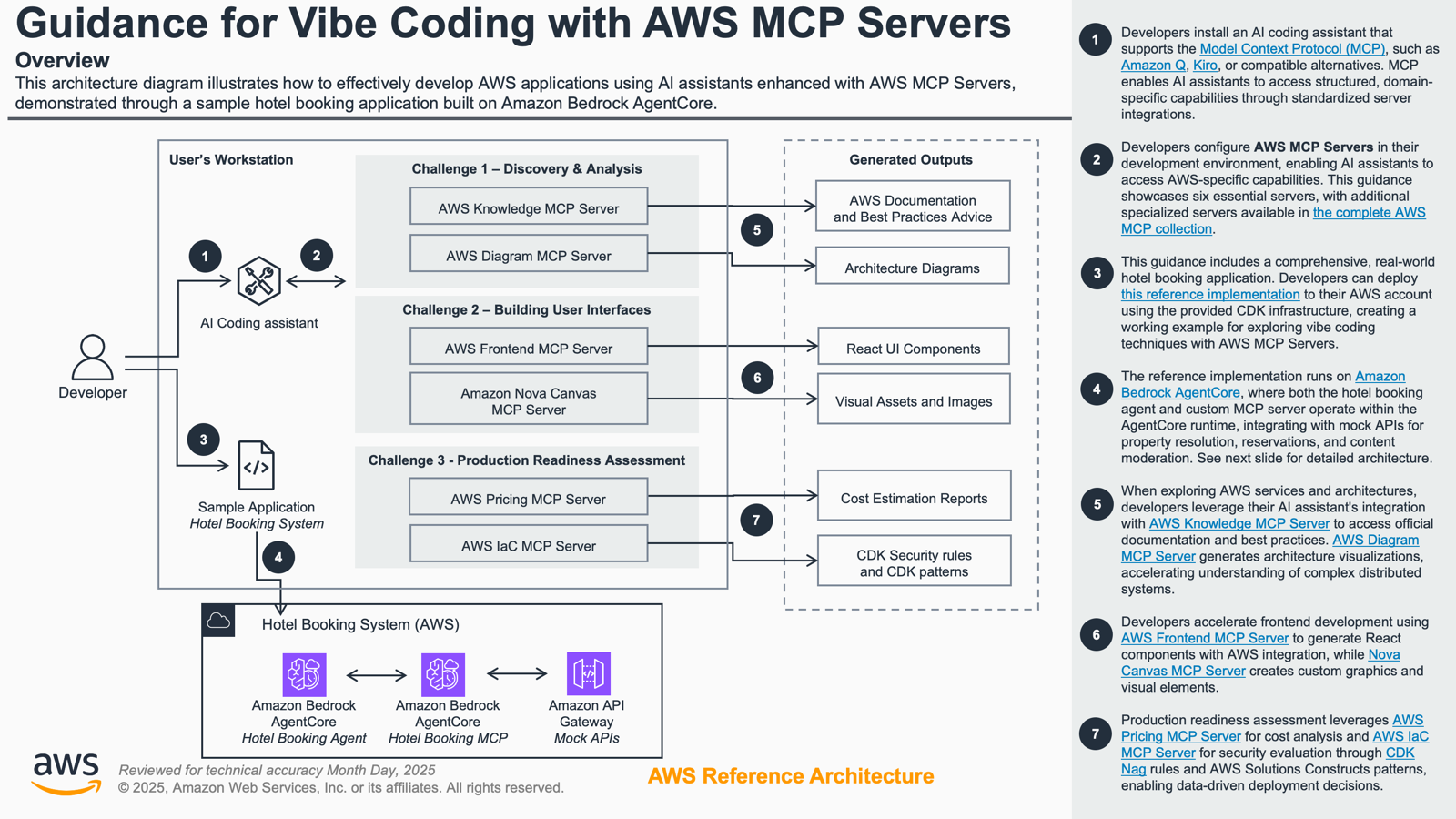
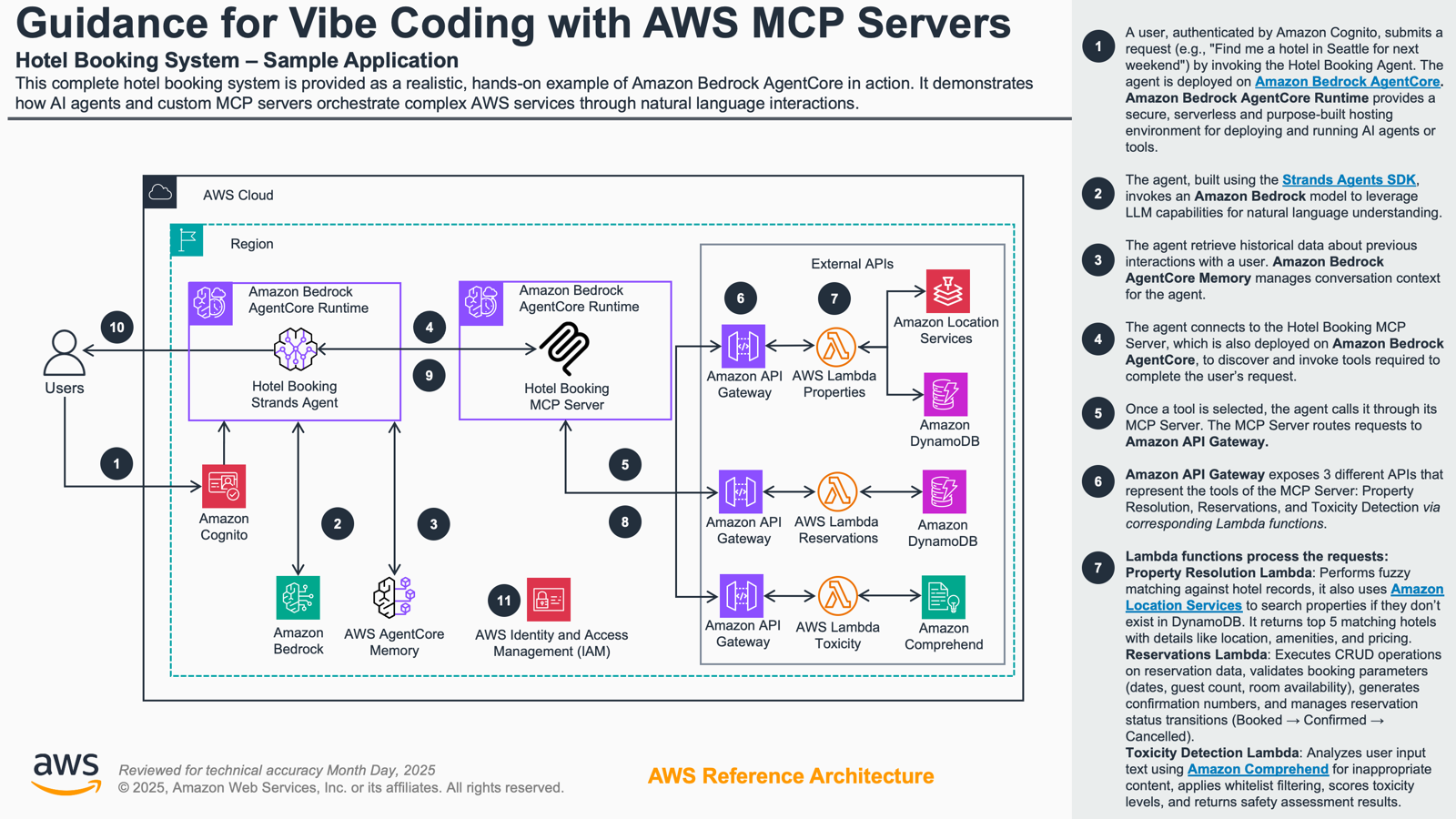
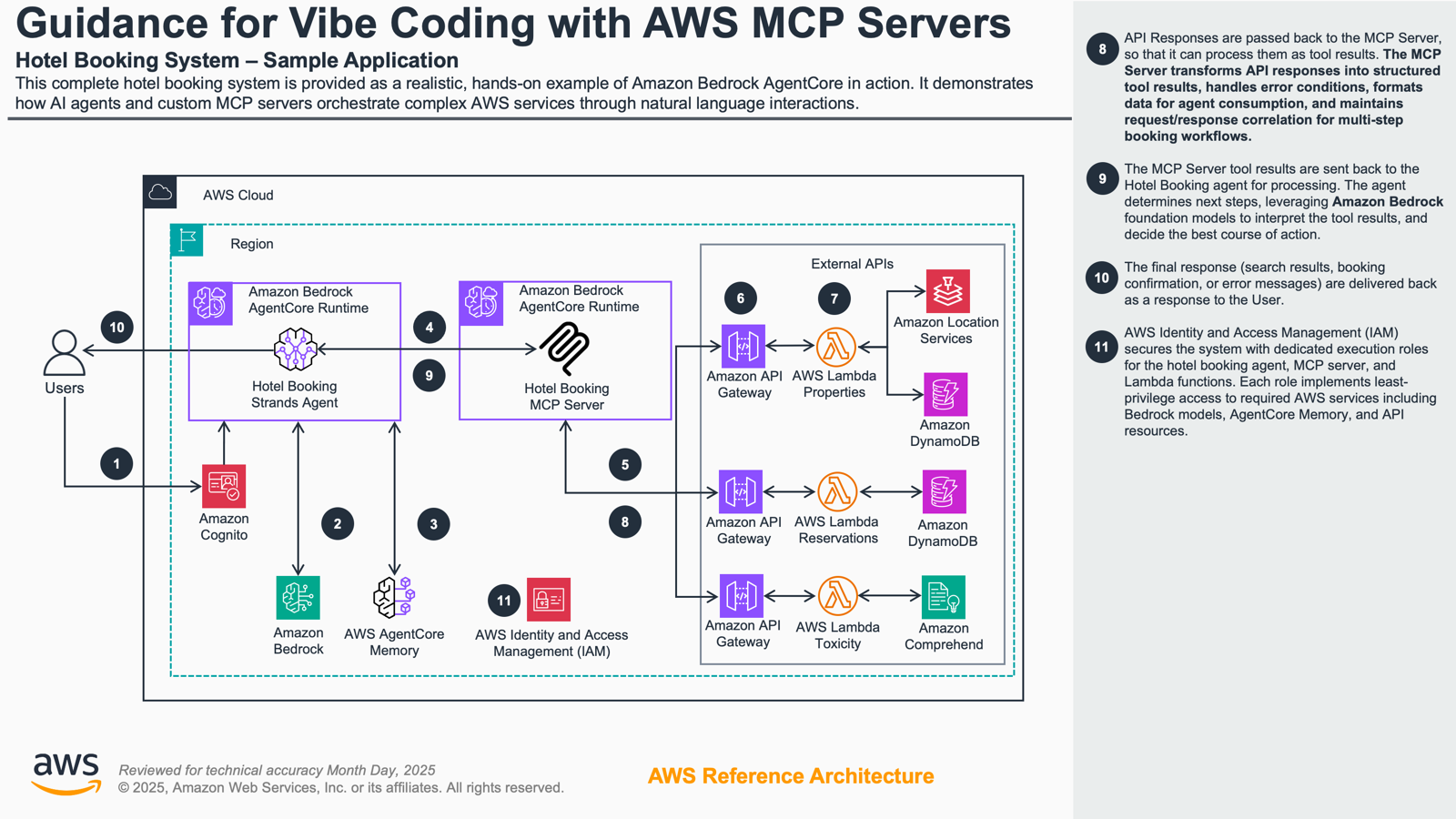
This Guidance demonstrates how to build AI-powered development workflows using Amazon Bedrock AgentCore and the Model Context Protocol (MCP). It provides a complete, deployable hotel booking agent system that showcases "vibe coding" techniques - an AI-assisted development approach that accelerates software development through intelligent code generation, discovery, and problem-solving.
Test This Server
Run this in your terminal to verify the server starts. Then let us know if it worked — your result helps other developers.
npx -y 'pnpm' 2>&1 | head -1 && echo "✓ Server started successfully"
After testing, let us know if it worked:
Loading README…
Scored, not listed
Why this score
Five weighted categories — click any category to see the underlying evidence.
Score breakdown
59/100across 5 weighted dimensions
0255075100
22
13
14
10
−41
Security
Maintenance
Efficiency
Documentation
Compatibility
Categoriesclick a row to see evidence
Security
OSV.dev12 fixed
CVE-2026-24131info · fixed
pnpm has Path Traversal via arbitrary file permission modification
### Summary When pnpm processes a package's `directories.bin` field, it uses `path.join()` without validating the result stays within the package root. A malicious npm package can specify `"directories": {"bin": "../../../../tmp"}` to escape the package directory, causing pnpm to chmod 755 files at arbitrary locations. **Note:** Only affects Unix/Linux/macOS. Windows is not affected (`fixBin` gated by `EXECUTABLE_SHEBANG_SUPPORTED`). ### Details Vulnerable code in `pkg-manager/package-bins/src
CVE-2026-23888medium · fixedCVSS 6.5
pnpm: Binary ZIP extraction allows arbitrary file write via path traversal (Zip Slip)
### Summary A path traversal vulnerability in pnpm's binary fetcher allows malicious packages to write files outside the intended extraction directory. The vulnerability has two attack vectors: (1) Malicious ZIP entries containing `../` or absolute paths that escape the extraction root via AdmZip's `extractAllTo`, and (2) The `BinaryResolution.prefix` field is concatenated into the extraction path without validation, allowing a crafted prefix like `../../evil` to redirect extracted files outsid
CVE-2026-23889medium · fixedCVSS 6.5
pnpm has Windows-specific tarball Path Traversal
### Summary A path traversal vulnerability in pnpm's tarball extraction allows malicious packages to write files outside the package directory on Windows. The path normalization only checks for `./` but not `.\`. On Windows, backslashes are directory separators, enabling path traversal. **This vulnerability is Windows-only.** ### Details **1. Incomplete Path Normalization (`store/cafs/src/parseTarball.ts:107-110`)** ```typescript if (fileName.includes('./')) { fileName = path.posix.join('/'
CVE-2026-23890medium · fixedCVSS 6.5
pnpm scoped bin name Path Traversal allows arbitrary file creation outside node_modules/.bin
### Summary A path traversal vulnerability in pnpm's bin linking allows malicious npm packages to create executable shims or symlinks outside of `node_modules/.bin`. Bin names starting with `@` bypass validation, and after scope normalization, path traversal sequences like `../../` remain intact. ### Details The vulnerability exists in the bin name validation and normalization logic: **1. Validation Bypass (`pkg-manager/package-bins/src/index.ts`)** The filter allows any bin name starting wit
CVE-2026-24056medium · fixedCVSS 6.5
pnpm has symlink traversal in file:/git dependencies
### Summary When pnpm installs a `file:` (directory) or `git:` dependency, it follows symlinks and reads their target contents without constraining them to the package root. A malicious package containing a symlink to an absolute path (e.g., `/etc/passwd`, `~/.ssh/id_rsa`) causes pnpm to copy that file's contents into `node_modules`, leaking local data. **Preconditions:** Only affects `file:` and `git:` dependencies. Registry packages (npm) have symlinks stripped during publish and are NOT affe
Community
Reviews
Be the first to review
Have you used this server?
Share your experience — it helps other developers decide.
How easy was setup?Did it work reliably?How was the documentation?
Sign in to write a review.
Frequently Asked Questions
- Is Guidance For Vibe Coding With Aws Mcp Servers safe to use?
- Guidance For Vibe Coding With Aws Mcp Servers has no known CVEs as of the latest MCPpedia security scan. It does not require authentication, so any local process can connect — keep this in mind in shared environments. Licensed under MIT.
- How do I install Guidance For Vibe Coding With Aws Mcp Servers?
- Guidance For Vibe Coding With Aws Mcp Servers supports copy-paste install configs on its MCPpedia page for Claude Desktop, Cursor, and Claude Code. Scroll to the Quick Install section and select your client.
- What AI clients work with Guidance For Vibe Coding With Aws Mcp Servers?
- Guidance For Vibe Coding With Aws Mcp Servers is compatible with claude-desktop, cursor, claude-code. It uses stdio and sse and http transport.
- Is Guidance For Vibe Coding With Aws Mcp Servers actively maintained?
- Guidance For Vibe Coding With Aws Mcp Servers is recently maintained — last commit was 67 days ago. It has 39 GitHub stars.
Related
Similar servers
Others in cloud / developer-tools
X
XcodeBuildMCP97XcodeBuildMCP provides tools for Xcode project management, simulator management, and app utilities.
6.0k 1
 Context797
Context7 Platform -- Up-to-date code documentation for LLMs and AI code editors
58.2k 2
 XcodeBuildMCP97
A Model Context Protocol (MCP) server and CLI that provides tools for agent use when working on iOS and macOS projects.
6.0k 2
 Jscpd97
Copy/paste detector for programming source code, supports 223 formats. AI-ready with token-efficient reporter, skill and MCP server.
5.8k 1
MCP Security Weekly
Get CVE alerts and security updates for Guidance For Vibe Coding With Aws Mcp Servers and similar servers.
Community
Discussion
Start a conversation
Ask a question, share a tip, or report an issue.
Has anyone used this with Cursor?How do you handle auth?Any alternatives?
Sign in to join the discussion.