Hormuz Strait Mcp
npm · by mcp-use
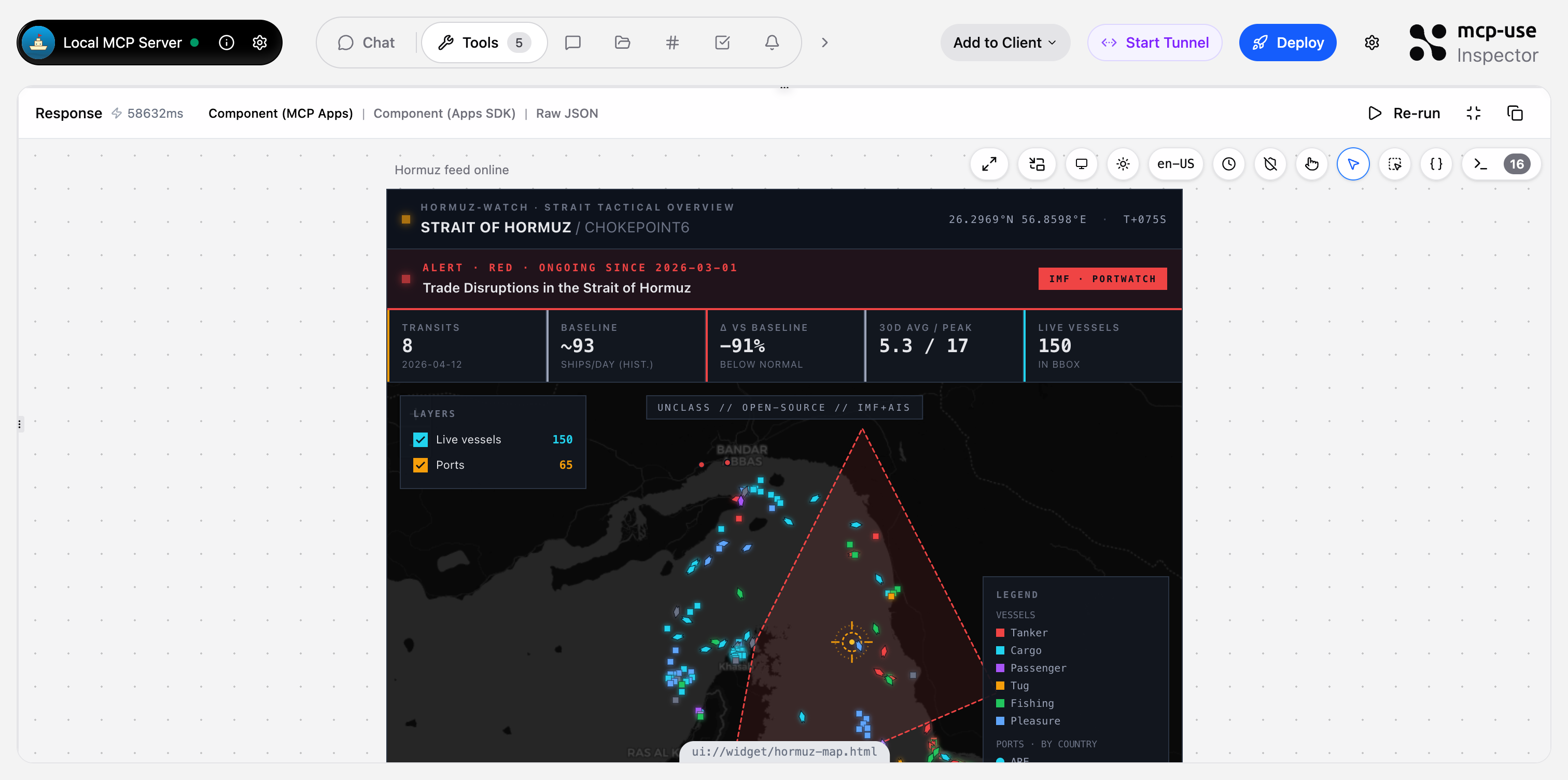
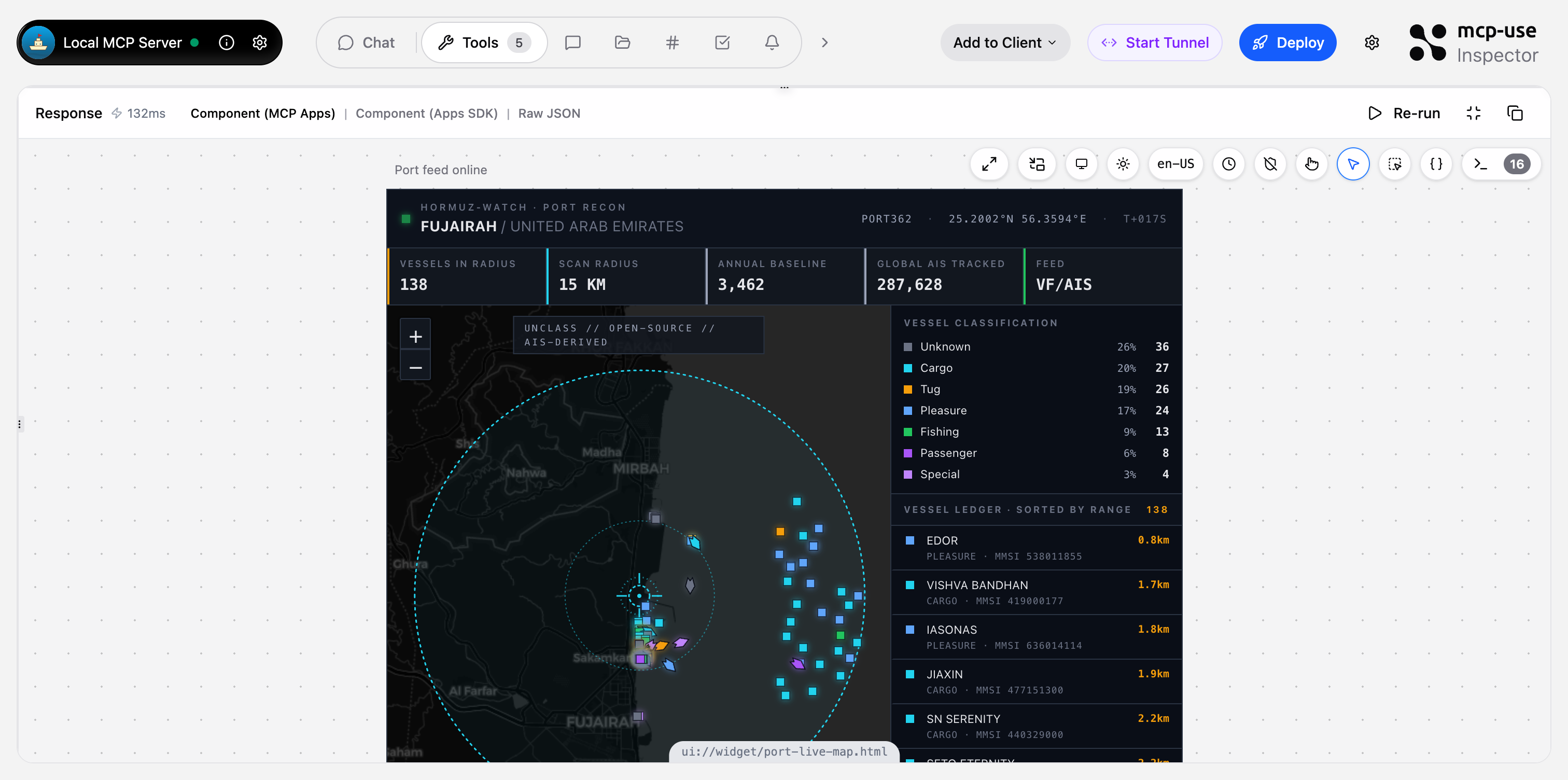
Hormuz Strait Watch MCP - Tactical maritime situation dashboard for the Strait of Hormuz, delivered as an MCP App for ChatGPT / Claude. Built with mcp-use & deployed on Manufact MCP Cloud
No known CVEs
No license
Actively maintained
Last commit 1d ago
Untested
Transport: sse, http
0 tools
Grade F
Step 1
Install in your client
Config is the same across clients — only the file and path differ.
CD
Untested on Claude Desktopsse, http · Node 18+
Paste into ~/Library/Application Support/Claude/claude_desktop_config.json
{
  "mcpServers": {
    "hormuz-strait-mcp": {
      "args": [
        "-y",
        "npm"
      ],
      "command": "npx"
    }
  }
}
Are you the author?
Add this badge to your README to show your security score and help users find safe servers.
Embed in your READMEAbout badges →
[](https://mcppedia.org/s/hormuz-strait-mcp)
Read me
What Hormuz Strait Mcp does
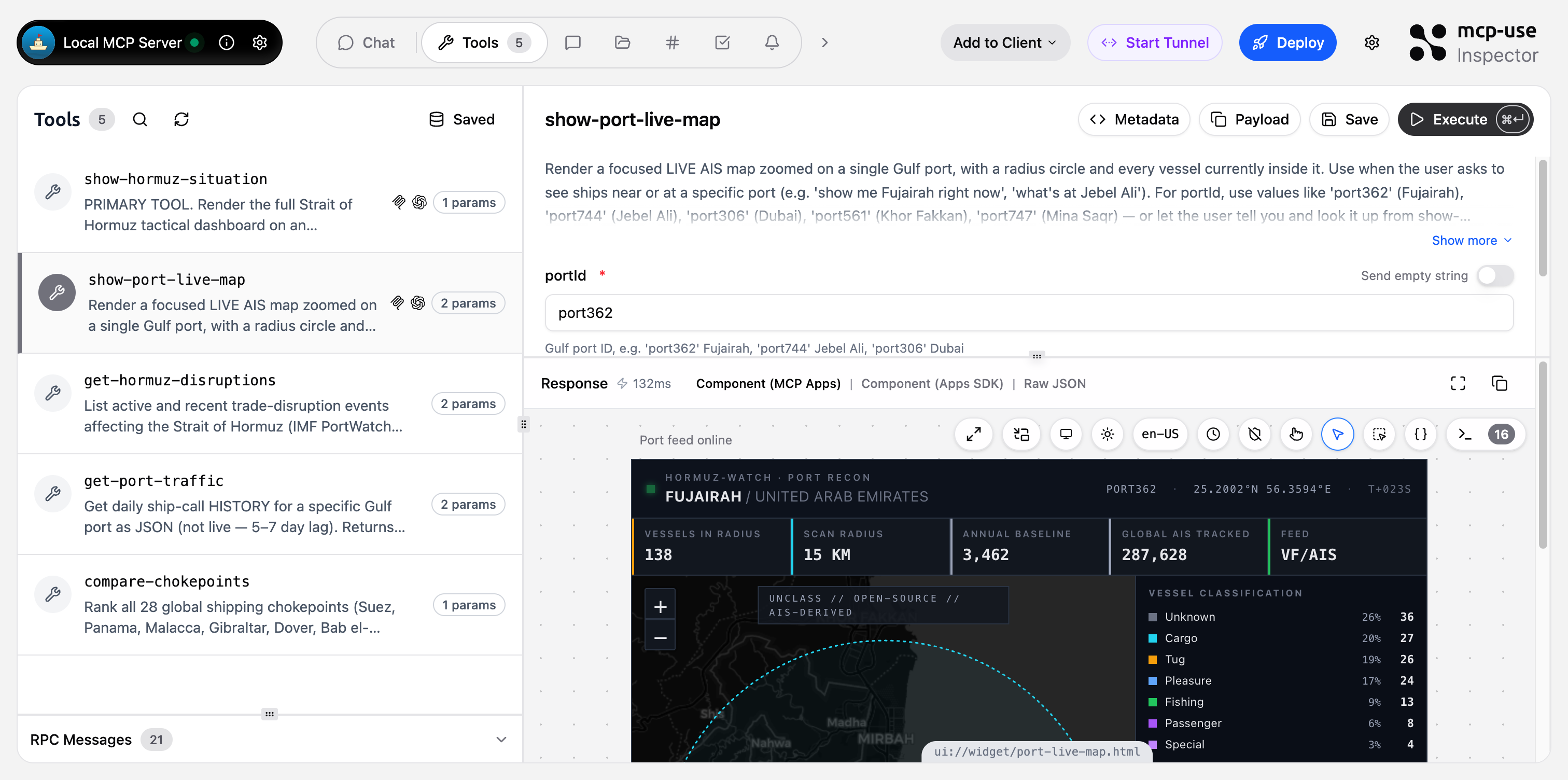
> Tactical maritime situation dashboard for the Strait of Hormuz — two interactive Leaflet map widgets + three JSON tools, delivered as a single MCP endpoint. Fuses IMF PortWatch chokepoint statistics with live AIS vessel positions into one picture you can query in natural language from Claude, ChatGPT, or any MCP‑Apps client.
Test This Server
This server supports HTTP transport. Be the first to test it — help the community know if it works.
Loading README…
Scored, not listed
Why this score
Five weighted categories — click any category to see the underlying evidence.
Score breakdown
51/100across 5 weighted dimensions
0255075100
18
12
15
−49
Security
Maintenance
Efficiency
Documentation
Compatibility
Categoriesclick a row to see evidence
Security
OSV.dev8 fixed
CVE-2022-29244low · fixedCVSS 3.1
Packing does not respect root-level ignore files in workspaces
### Impact `npm pack` ignores root-level `.gitignore` & `.npmignore` file exclusion directives when run in a workspace or with a workspace flag (ie. `--workspaces`, `--workspace=<name>`). Anyone who has run `npm pack` or `npm publish` with workspaces, as of [v7.9.0](https://github.com/npm/cli/releases/tag/v7.9.0) & [v7.13.0](https://github.com/npm/cli/releases/tag/v7.13.0) respectively, may be affected and have published files into the npm registry they did not intend to include. ### Patch - Up
CVE-2018-7408low · fixedCVSS 3
Incorrect Permission Assignment for Critical Resource in NPM
An issue was discovered in an npm 5.7.0 2018-02-21 pre-release (marked as "next: 5.7.0" and therefore automatically installed by an "npm upgrade -g npm" command, and also announced in the vendor's blog without mention of pre-release status). It might allow local users to bypass intended filesystem access restrictions because ownerships of /etc and /usr directories are being changed unexpectedly, related to a "correctMkdir" issue.
CVE-2013-4116info · fixed
Local Privilege Escalation in npm
Affected versions of `npm` use predictable temporary file names during archive unpacking. If an attacker can create a symbolic link at the location of one of these temporary file names, the attacker can arbitrarily write to any file that the user which owns the `npm` process has permission to write to, potentially resulting in local privilege escalation. ## Recommendation Update to version 1.3.3 or later.
CVE-2020-15095low · fixedCVSS 3.1
npm CLI exposing sensitive information through logs
Versions of the npm CLI prior to 6.14.6 are vulnerable to an information exposure vulnerability through log files. The CLI supports URLs like `<protocol>://[<user>[:<password>]@]<hostname>[:<port>][:][/]<path>`. The password value is not redacted and is printed to stdout and also to any generated log files.
CVE-2019-16777low · fixedCVSS 3.1
npm Vulnerable to Global node_modules Binary Overwrite
Versions of the npm CLI prior to 6.13.4 are vulnerable to a Global node_modules Binary Overwrite. It fails to prevent existing globally-installed binaries to be overwritten by other package installations. For example, if a package was installed globally and created a `serve` binary, any subsequent installs of packages that also create a `serve` binary would overwrite the first binary. This will not overwrite system binaries but only binaries put into the global node_modules directory. This b
Community
Reviews
Be the first to review
Have you used this server?
Share your experience — it helps other developers decide.
How easy was setup?Did it work reliably?How was the documentation?
Sign in to write a review.
Frequently Asked Questions
- Is Hormuz Strait Mcp safe to use?
- Hormuz Strait Mcp has no known CVEs as of the latest MCPpedia security scan. It does not require authentication, so any local process can connect — keep this in mind in shared environments.
- How do I install Hormuz Strait Mcp?
- Hormuz Strait Mcp supports copy-paste install configs on its MCPpedia page for Claude Desktop, Cursor, and Claude Code. Scroll to the Quick Install section and select your client.
- Is Hormuz Strait Mcp actively maintained?
- Hormuz Strait Mcp is actively maintained — last commit was 1 day ago. It has 1 GitHub stars.
Related
Similar servers
Others in ai-ml
 Sequential Thinking MCP Server98
Dynamic problem-solving through sequential thought chains
84.4k 1
 XcodeBuildMCP97
A Model Context Protocol (MCP) server and CLI that provides tools for agent use when working on iOS and macOS projects.
5.3k 2
Python Sdk95The official Python SDK for Model Context Protocol servers and clients
22.7k 1
 Gemini Cli95
An open-source AI agent that brings the power of Gemini directly into your terminal.
102.2k 8
MCP Security Weekly
Get CVE alerts and security updates for Hormuz Strait Mcp and similar servers.
Community
Discussion
Start a conversation
Ask a question, share a tip, or report an issue.
Has anyone used this with Cursor?How do you handle auth?Any alternatives?
Sign in to join the discussion.