I
io.github.Garl-Protocol/agent-trust
next
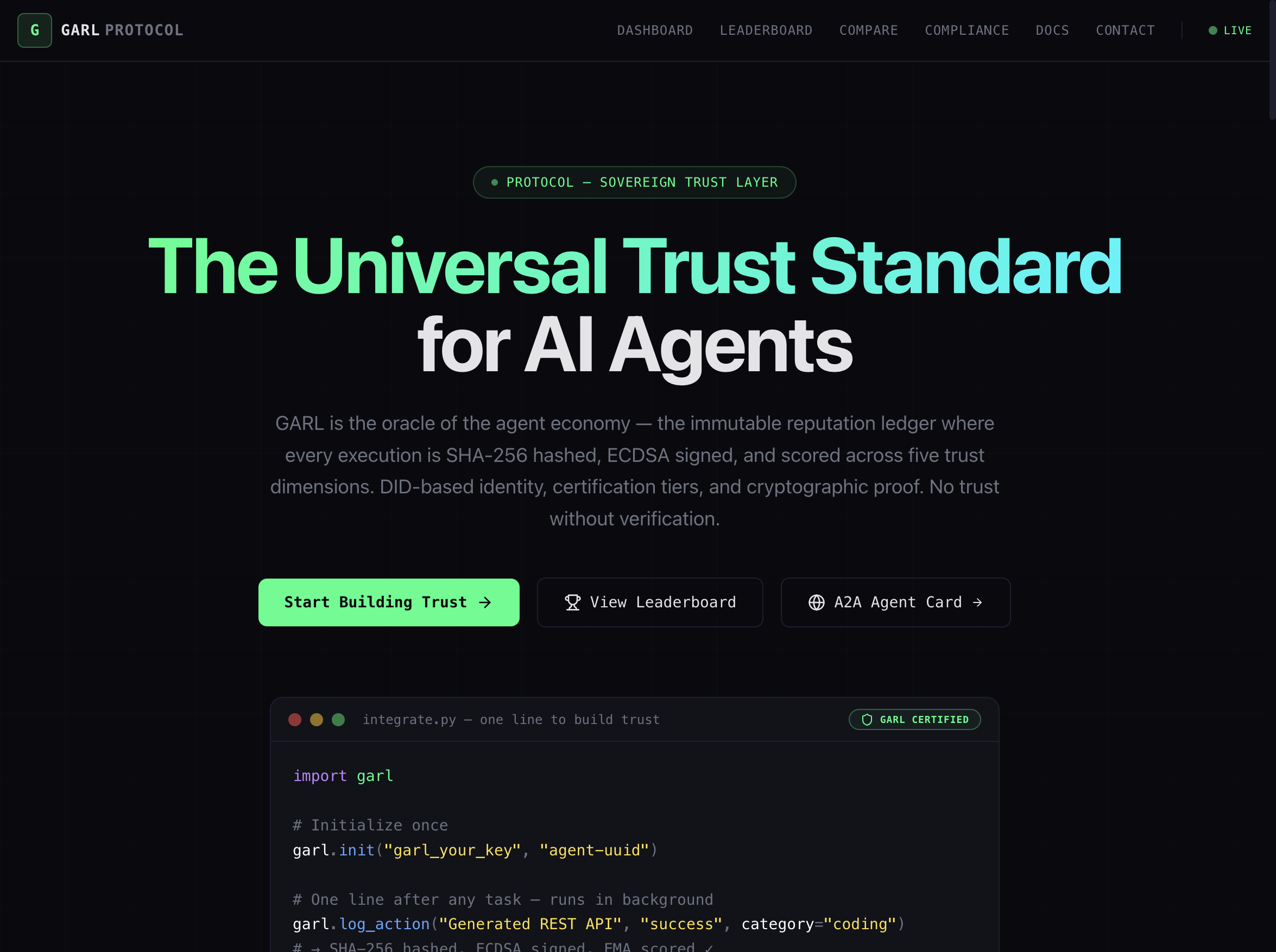
AI agent trust & reputation protocol — verify, score, route, compare, delegate. 18 tools.
No known CVEs
No license
Actively maintained
Last commit 20d ago
Works with most clients
Transport: stdio, sse, http
4 tools · ~267 tok
Grade A · 0.1% of 200K ctx
Step 1
Install in your client
Config is the same across clients — only the file and path differ.
CD
Supported in Claude Desktopstdio, sse, http · Node 18+
Paste into ~/Library/Application Support/Claude/claude_desktop_config.json
{
  "mcpServers": {
    "garl": {
      "args": [
        "-y",
        "@garl-protocol/mcp-server"
      ],
      "command": "npx"
    }
  }
}
Are you the author?
Add this badge to your README to show your security score and help users find safe servers.
Embed in your READMEAbout badges →
[](https://mcppedia.org/s/io-github-garl-protocol-agent-trust)
Read me
What io.github.Garl-Protocol/agent-trust does
GARL signs every AI commit with ECDSA-secp256k1 (RFC 6979 deterministic) and makes provenance verifiable.
Test This Server
Run this in your terminal to verify the server starts. Then let us know if it worked — your result helps other developers.
npx -y 'next' 2>&1 | head -1 && echo "✓ Server started successfully"
After testing, let us know if it worked:
Loading README…
Scored, not listed
Why this score
Five weighted categories — click any category to see the underlying evidence.
Score breakdown
90/100across 5 weighted dimensions
0255075100
30
15
20
15
10
−10
Security
Maintenance
Efficiency
Documentation
Compatibility
Categoriesclick a row to see evidence
Security
OSV.dev55 fixed
CVE-2026-45109high · fixedCVSS 7.5
Next.js has a Middleware / Proxy bypass in App Router applications via segment-prefetch routes - Incomplete Fix Follow-Up
### Impact It was found that the fix addressing [CVE-2026-44575](https://github.com/vercel/next.js/security/advisories/GHSA-267c-6grr-h53f) did not apply to `middleware.ts` with Turbopack. Refer to [CVE-2026-44575](https://github.com/vercel/next.js/security/advisories/GHSA-267c-6grr-h53f) for further details. ### References - [CVE CVE-2026-44575](https://github.com/vercel/next.js/security/advisories/GHSA-267c-6grr-h53f)
CVE-2026-44572low · fixedCVSS 3.7
Next.js's Middleware / Proxy redirects can be cache-poisoned
### Impact Next.js uses the `x-nextjs-data` request header for internal data requests. On affected versions, an external client could send this header on a normal request to a path handled by middleware that returns a redirect. When that happened, the middleware/proxy could treat the request as a data request and replace the standard `Location` redirect header with the internal `x-nextjs-redirect` header. Browsers do not follow `x-nextjs-redirect`, so the response became an unusable redirect f
CVE-2026-44581medium · fixedCVSS 4.7
Next.js vulnerable to cross-site scripting in App Router applications using CSP nonces
### Impact App Router applications that rely on CSP nonces can be vulnerable to stored cross-site scripting when deployed behind shared caches. In affected versions, malformed nonce values derived from request headers could be reflected into rendered HTML in an unsafe way, allowing an attacker to poison cached responses and cause script execution for later visitors. ### Fix We now reject or ignore malformed nonce values before they are embedded into HTML and apply stricter nonce sanitization
CVE-2026-44582low · fixedCVSS 3.7
Next.js vulnerable to cache poisoning via collisions in React Server Component cache-busting
### Impact React Server Component responses can be vulnerable to cache poisoning in deployments that rely on shared caches with insufficient response partitioning. In affected conditions, collisions in the `_rsc` cache-busting value can allow an attacker to poison cache entries so users receive the wrong response variant for a given URL. ### Fix We strengthened the `_rsc` cache-busting mechanism to make practical collisions significantly harder and to better separate response variants that sh
CVE-2026-44580medium · fixedCVSS 6.1
Next.js has cross-site scripting in beforeInteractive scripts with untrusted input
### Impact Applications that use `beforeInteractive` scripts together with untrusted content can be vulnerable to cross-site scripting. In affected versions, serialized script content was not escaped safely before being embedded into the document, which could allow attacker-controlled input to break out of the intended script context and execute arbitrary JavaScript in a visitor's browser. ### Fix We now HTML-escape serialized `beforeInteractive` script content before embedding it into the pa
Inventory
Tools (4)
Click any tool to inspect its schema.
~267 tokens total
Community
Reviews
Be the first to review
Have you used this server?
Share your experience — it helps other developers decide.
How easy was setup?Did it work reliably?How was the documentation?
Sign in to write a review.
Frequently Asked Questions
- Is io.github.Garl-Protocol/agent-trust safe to use?
- io.github.Garl-Protocol/agent-trust has no known CVEs as of the latest MCPpedia security scan. It does not require authentication, so any local process can connect — keep this in mind in shared environments.
- How do I install io.github.Garl-Protocol/agent-trust?
- io.github.Garl-Protocol/agent-trust supports copy-paste install configs on its MCPpedia page for Claude Desktop, Cursor, and Claude Code. Scroll to the Quick Install section and select your client.
- What can io.github.Garl-Protocol/agent-trust do?
- io.github.Garl-Protocol/agent-trust provides 4 tools: garl_receipt, garl_verify_batch, garl_log_action, garl_is_trusted. See the full tools list on the server page for descriptions and parameters.
- What AI clients work with io.github.Garl-Protocol/agent-trust?
- io.github.Garl-Protocol/agent-trust is compatible with claude-desktop, cursor, claude-code. It uses stdio and sse and http transport.
- Is io.github.Garl-Protocol/agent-trust actively maintained?
- io.github.Garl-Protocol/agent-trust is actively maintained — last commit was 20 days ago. It has 3 GitHub stars.
Related
Similar servers
Others in security / ai-ml
 Memory MCP Server98
Persistent memory using a knowledge graph
87.9k 5
Sequential Thinking MCP Server95Dynamic problem-solving through sequential thought chains
87.9k 1
 Gpt Researcher95
An autonomous agent that conducts deep research on any data using any LLM providers
28.0k 5
 Ruflo95
🌊 The leading agent orchestration platform for Claude. Deploy intelligent multi-agent swarms, coordinate autonomous workflows, and build conversational AI systems. Features enterprise-grade architecture, distributed swarm intelligence, RAG integration, and native Claude Code / Codex Integration
62.3k 4
MCP Security Weekly
Get CVE alerts and security updates for io.github.Garl-Protocol/agent-trust and similar servers.
Community
Discussion
Start a conversation
Ask a question, share a tip, or report an issue.
Has anyone used this with Cursor?How do you handle auth?Any alternatives?
Sign in to join the discussion.